Short answer
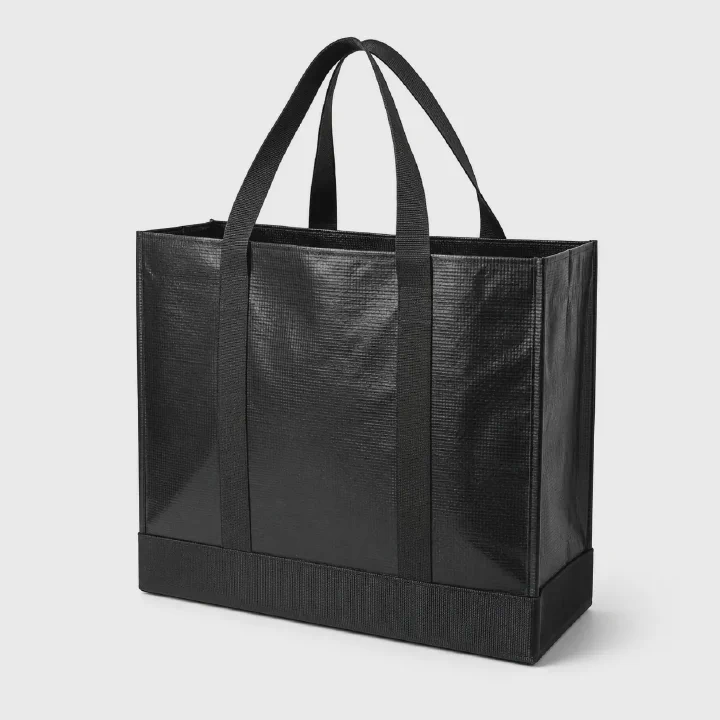
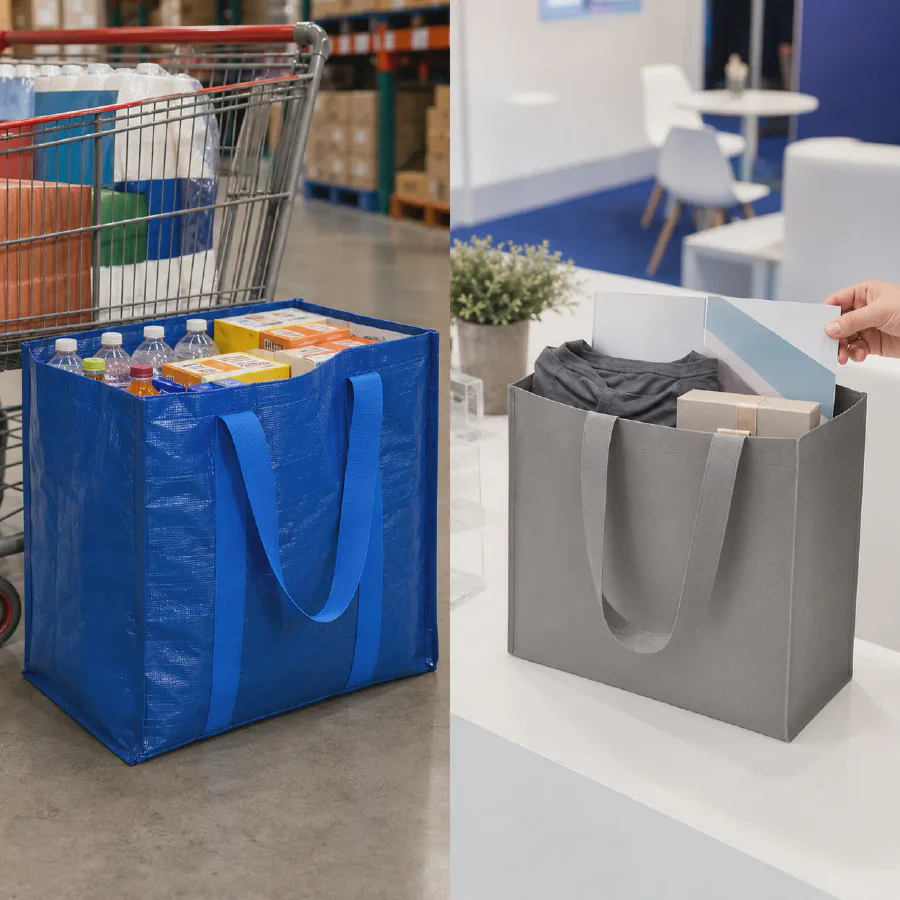
Choose PP woven for grocery, moving, storage or other large-capacity bags that need reinforced handles and repeated load carrying. Choose non-woven PP for lighter retail and promotional bags where softness, low unit weight and a simple presentation matter more than high capacity. Neither material is automatically better: compare the complete bag construction under the intended load.
The practical dividing line is not whether both bags are called “reusable.” It is the combination of contents, finished size, working load, carrying distance and expected reuse cycles. A lightweight event tote and a warehouse-club grocery bag solve different jobs even when both are made from polypropylene.
For a closer look at woven construction, read what a PP woven shopping bag is. Buyers choosing a high-load format should also compare heavy-duty shopping tote bags with lighter promotional retail bag applications.
What is the structural difference?
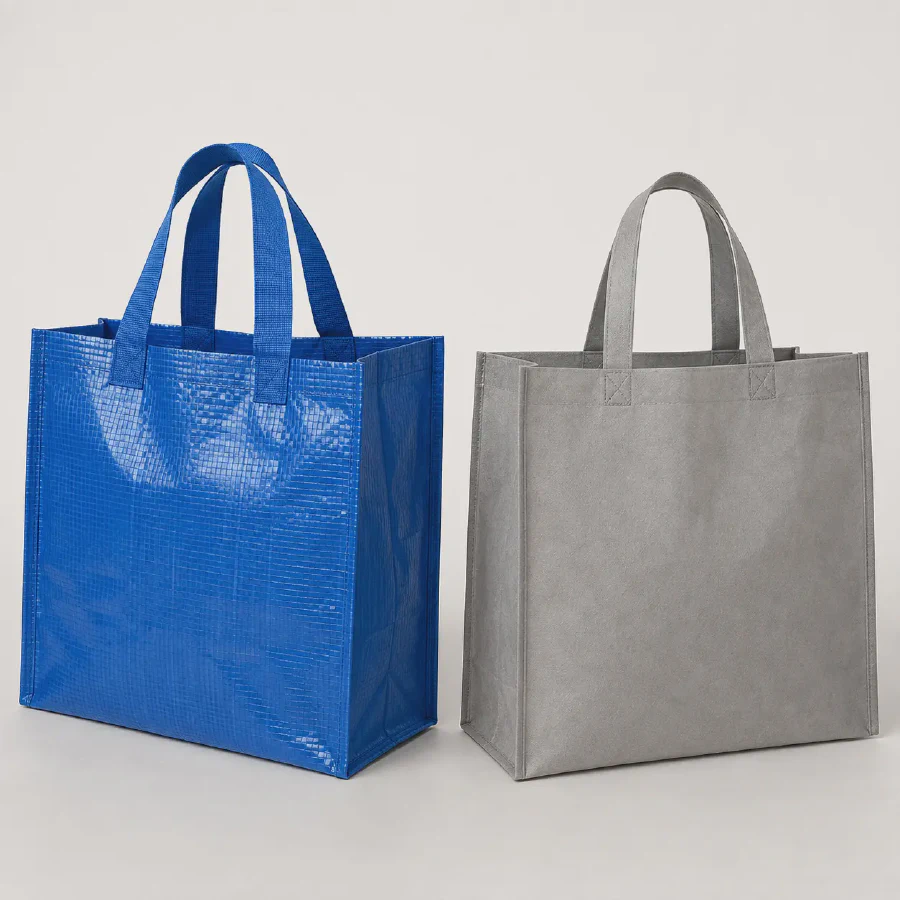
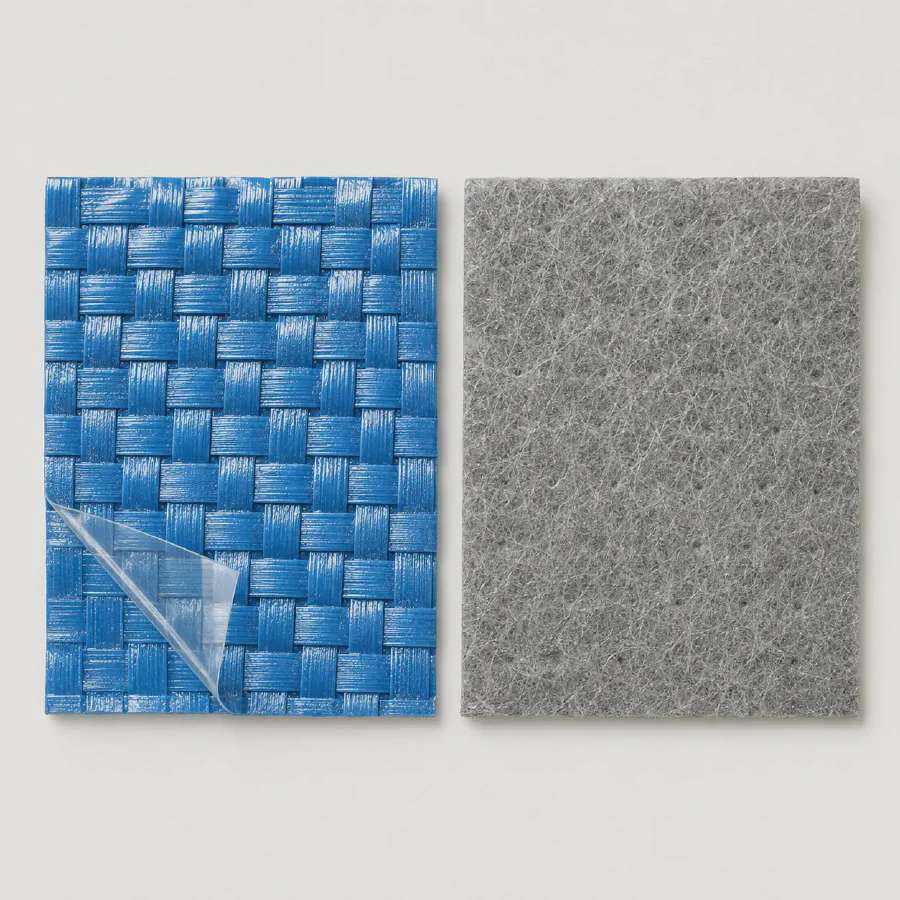
PP woven fabric is made from polypropylene tapes interlaced in two directions. The grid distributes tension across the panel and supports laminated, gusseted and box-shaped constructions. Non-woven PP is made by bonding fibers into a sheet. It feels more textile-like but is normally used for lighter-duty formats.
Woven fabric has visible warp and weft tapes. Its structure gives the panel directional strength and makes it suitable for wide gussets, stitched seams, edge binding and webbing that can continue around the bag. A coating or printed film may be laminated to the fabric for moisture resistance, easier cleaning and detailed graphics.
Non-woven fabric is a web of fibers bonded by heat, pressure or another manufacturing process. It can be cut and sewn or heat sealed into simple tote shapes. The sheet is light and soft, but its strength at a seam or handle attachment depends heavily on fabric weight, bonding quality and the amount of material captured by the stitch or seal.
| Buying factor | PP woven | Non-woven PP |
|---|---|---|
| Typical application | Grocery, storage, moving, warehouse-club bags | Events, lightweight retail and giveaways |
| Capacity | Well suited to wide gussets and large volumes | Usually small to medium |
| Reinforcement | Webbing, binding, wraparound handles | Stitched or heat-sealed handles |
| Surface | Woven texture or laminated film | Soft bonded-fiber texture |
| Graphics | Surface print or full-color printed lamination | Screen, flexographic or transfer print |
| Foldability | Flexible; heavier constructions fold less tightly | Usually light and easy to fold |
Material weight is not directly interchangeable. A supplier may quote woven fabric in grams per square meter, tape or coating terms, while non-woven fabric is commonly specified by GSM. Two bags with the same quoted GSM can still perform differently because the fabric structure, seam allowance, handle material and finished dimensions are different.
How should strength be compared?
Do not compare material names alone. Ask suppliers to build samples with the same finished dimensions, handle drop and target contents. Test the complete bag because failure may occur at a handle attachment, top edge, seam or closure before the body material fails.
For a useful comparison, define the working load, lifting method, carrying distance, number of cycles and whether the test uses static hanging or repeated handling. A quoted maximum load without these conditions is not a reliable purchasing specification.
Use a test that resembles real handling. Fill the bag with representative contents rather than a compact steel weight when shape and edge pressure matter. Lift it by both handles, carry it the expected distance, set it down and repeat. Inspect handle stitches, webbing elongation, top-edge distortion, seam opening and permanent body stretch after the agreed number of cycles.
For large woven bags, confirm whether webbing terminates near the top or wraps under the base. Wraparound webbing can transfer load away from a small handle patch, but it does not correct weak stitching or an unsuitable seam. For non-woven bags, check whether handles are sewn, cross-stitched, ultrasonically bonded or heat sealed, and request evidence that the chosen attachment works with the specified fabric weight.
Which printing method fits each material?
Non-woven PP commonly uses screen or flexographic printing for simple logos and limited-color artwork. The soft surface and fabric texture can reduce very fine detail. Print coverage, ink compatibility and rub resistance should be approved on the actual production material rather than on a paper proof.
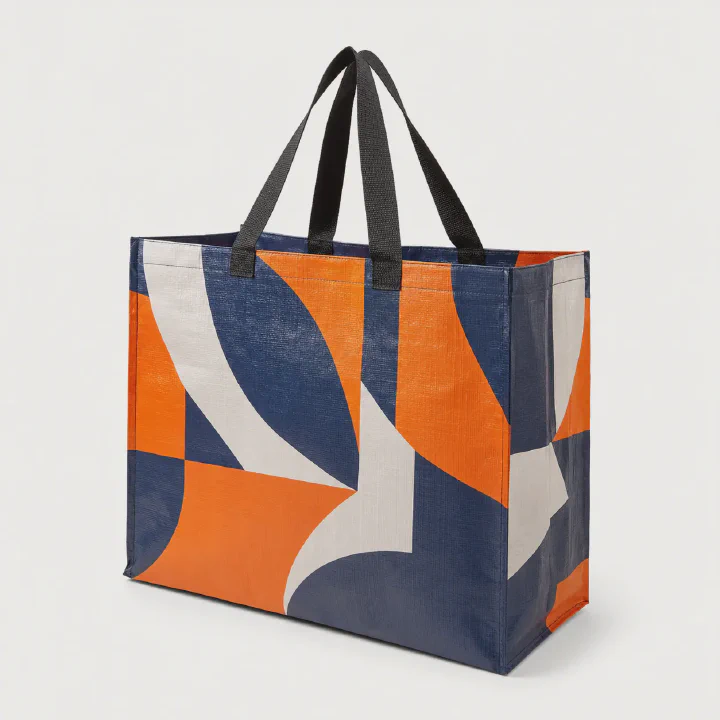
PP woven can be printed directly for basic graphics or laminated with a reverse-printed BOPP film for full-color retail artwork. Printed lamination gives a smoother visual surface and protects ink beneath the film, but artwork must account for gussets, seams, handle positions, folds and trimming tolerance. A clean digital mock-up is useful, but an approved physical sample remains the production reference.
How should cost be compared?
Non-woven PP is often economical for a simple, lightweight promotional bag. Laminated woven PP may cost more per unit but can offer a larger print surface, cleaner photographic graphics and a longer intended reuse cycle. Evaluate cost per intended use, not only unit price.
Compare quotations only after aligning the specification. A cheaper bag may use a lower body weight, narrower handle, shorter reinforcement path, fewer stitches, smaller finished gusset or different packing quantity. These changes can affect carrying performance and freight efficiency more than a small unit-price difference.
Total landed cost should include sample charges, printing plates or cylinders, packing method, carton dimensions, freight volume, import costs and expected rejection or replacement risk. If the bag is part of a retail program, also consider whether print inconsistency or dimensional drift will disrupt shelf presentation and packing operations.
Are PP woven and non-woven bags recyclable?
Both materials may be recyclable where appropriate polypropylene collection exists. Recycling depends on local infrastructure and on whether incompatible inserts, coatings, zippers, labels or decorations can be separated. Reuse claims should also match actual durability and customer behavior.
“Made from PP” does not guarantee that a used bag will be accepted locally. Ask how the finished bag is constructed, identify mixed-material components and avoid unsupported environmental claims. A more credible specification states the intended reuse, the material composition and any available disposal route for the target market.
What should an RFQ include?
- Intended contents and target working load
- Finished width × height × gusset
- Hand-carry or shoulder-carry handle drop
- Expected reuse cycle
- Open top, tab or zipper
- Print colors, coverage and artwork method
- Quantity, packing method and destination
- Required sample and load-test method
Also ask the supplier to state tolerances for finished dimensions, fabric or body weight, print color and placement. The purchase order should identify the approved sample or signed specification as the acceptance reference. For repeat orders, record any permitted material or process changes rather than allowing silent substitutions.
Recommended sample approval sequence
- Material swatch: confirm texture, color, lamination and print compatibility.
- Pre-production sample: verify finished size, gusset, handle drop, closure and artwork position.
- Functional test: load and cycle the actual construction using representative contents.
- Packing sample: confirm folding, unit packing, carton quantity and shipping marks.
- Production inspection: compare bulk goods with the signed sample and agreed tolerances.
Decision rule
Start with PP woven when the bag is large, frequently loaded, exposed to light moisture or expected to retain a structured shape. Start with non-woven PP when the load is light and the project prioritizes a soft promotional tote, compact storage and lower material weight. If the application sits between those cases, obtain one representative sample of each and test them under the same conditions.
The final buying decision should be expressed as a construction—not merely a material name. State the body material and weight, finished dimensions, handle and seam method, closure, printing, target load, reuse expectation, tolerances and test method. That gives suppliers enough information to quote comparable bags and gives the buyer a measurable basis for approval.