Short answer
A wholesale moving bag should be specified around what goes inside, how heavy it normally is and how the bag will be handled. Start with the contents and handling route, then define the finished dimensions, woven body, lamination, opening, zipper, handle load path, seams, base, identification features and packing.
Do not buy by a product photo or a supplier’s general “heavy-duty” claim. Two bags can look almost identical while using different body weights, webbing paths, zipper assemblies and seam reinforcement. The approved sample, specification sheet and finished-bag test method should therefore be controlled as one purchasing record.
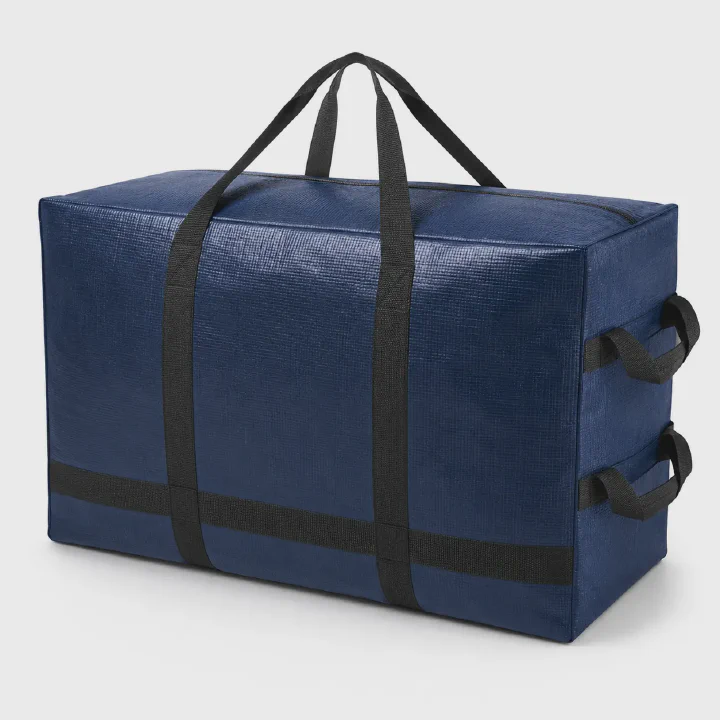
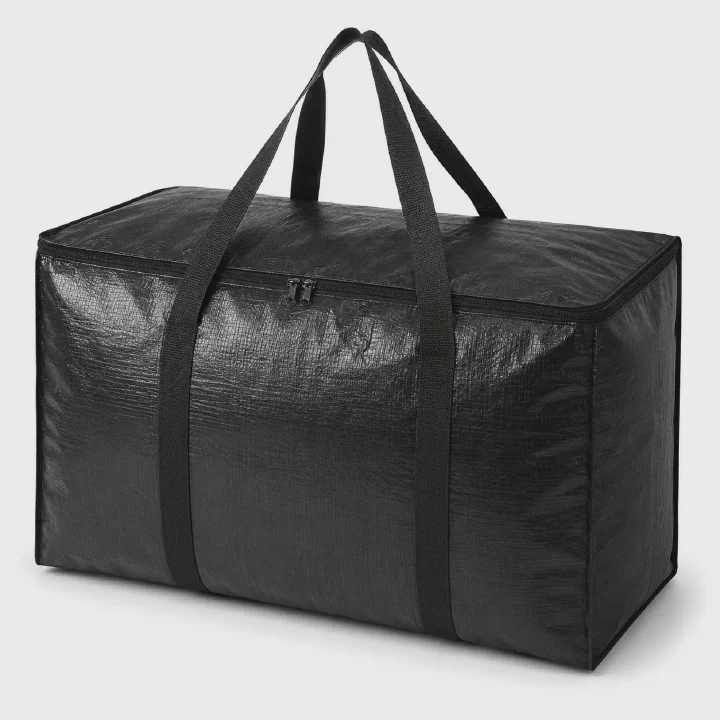
Review heavy-duty moving bags and zippered moving bags as two different construction starting points. For the load path itself, use the dedicated moving bag handle-strength guide.
1. Define the moving job before the bag
The phrase “moving bag” covers very different applications. A bag for duvets has a different load profile from one used for books. A bag carried from a bedroom to a van has different handling demands from one repeatedly issued by a commercial relocation company.
Before requesting a quote, describe five conditions:
- Contents: clothes, bedding, toys, books, mixed household goods or another defined load.
- Normal filled weight: the realistic working load, not the greatest number that can be forced into the bag.
- Handling route: floor lifts, stairs, trolley movement, vehicle loading, stacking and storage.
- Access frequency: packed once, reopened during a move or used repeatedly between jobs.
- Service life: single project, household reuse or commercial rotation.
These answers determine whether volume, abrasion resistance, handle comfort, closure security or compact empty storage deserves priority.
Storage bag versus relocation bag
| Buying condition | Storage-focused bag | Relocation-focused bag |
|---|---|---|
| Main duty | Contain and protect bulky items | Be lifted, carried, shifted and stacked |
| Typical priority | Volume, dust protection, visibility | Load transfer, closure, handling control |
| Handle demand | Occasional repositioning | Repeated lifting from multiple angles |
| Base demand | Stable on shelf or floor | Resist concentrated load and dragging risk |
| Test emphasis | Fit, closure and storage stability | Finished-bag lift and handling cycle |
A storage bag is not automatically unsuitable for moving, but its construction must be verified for the intended handling. Product naming is not evidence of performance.
2. Convert the contents into finished dimensions
Moving bags are commonly specified as finished width × height × gusset. Buyers and suppliers should confirm the measurement convention because a flat measurement, an external finished measurement and a usable internal space are not the same thing.
Use the actual contents to create a load envelope:
- Arrange the goods in the orientation users will normally pack them.
- Measure the occupied width, height and depth without excessive compression.
- Add practical loading and closure clearance.
- Check whether the packed shape remains stable when lifted.
- Confirm the filled bag passes through relevant doors, corridors and vehicle openings.
An oversized bag is not always more useful. It can encourage overloading, allow dense items to shift, drag against the user’s legs and consume unnecessary carton or warehouse volume. An undersized bag may force the zipper, distort seams or prevent the top from closing.
Capacity and weight are separate
Capacity describes volume; working load describes weight. Bulky bedding can occupy a large bag at a moderate weight, while books can create a much higher load in less space. A capacity claim should never be treated as a load claim.
For a repeat program, approve the size using a filled physical sample rather than a calculation alone. A sample reveals whether the opening is accessible, the packed bag is balanced and the handles sit in a controllable position.
3. Specify the body material correctly
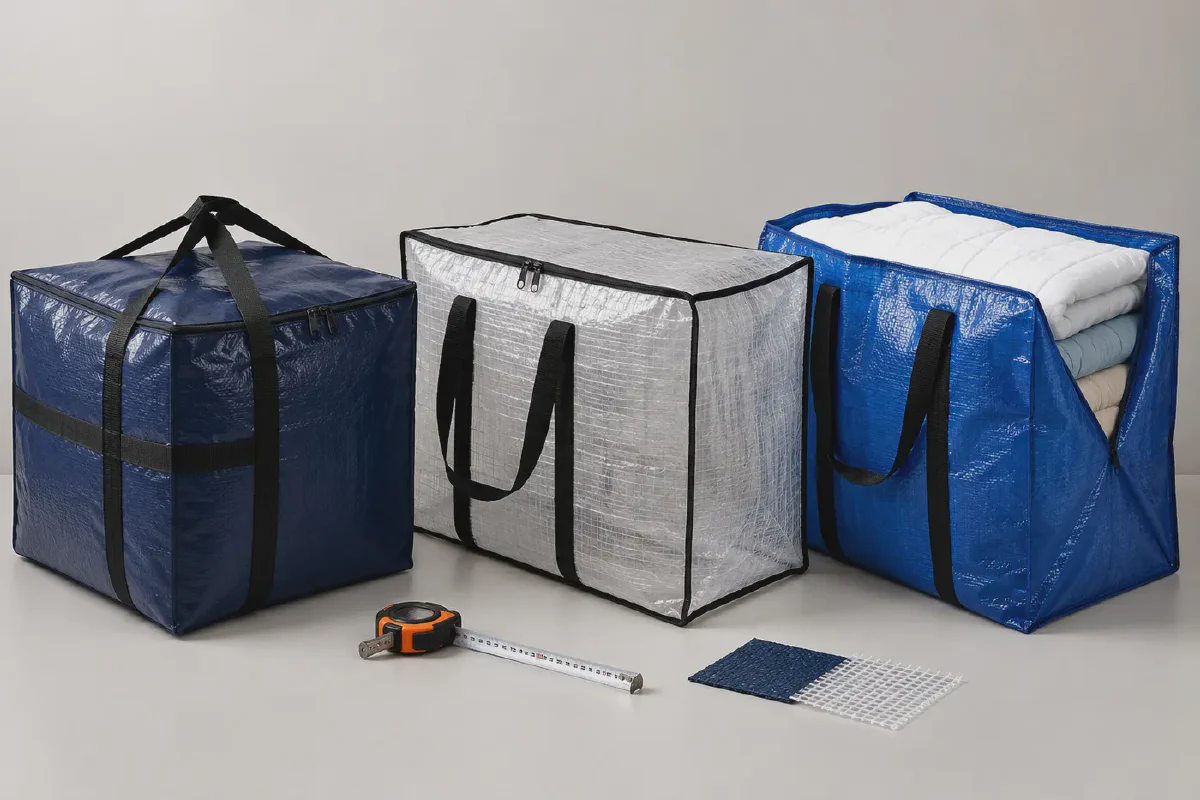
Most reusable moving bags in this category use a woven polypropylene base. The woven tapes provide the structural body; an optional coating or laminated film changes the surface, appearance and moisture resistance.
The material line in an RFQ should separate:
- woven base construction and nominal weight;
- coating or film type and contribution;
- finished color and visual standard;
- surface finish, such as matte or glossy where relevant;
- any recycled-content or compliance requirement;
- agreed tolerance and test method.
“PP woven material” is too broad for a production specification. Equally, one total GSM number can hide a different balance between woven base and outer film. The body must also be evaluated as part of the finished construction: a heavier sheet does not compensate for a weak handle attachment or an unsuitable seam.
Laminated or unlaminated
Lamination can provide a more wipe-clean surface, greater print coverage and additional protection from light incidental moisture. It does not make every seam, zipper or needle hole watertight. If the buyer needs rain exposure, damp-floor contact or long-term moisture protection, the exposure condition and acceptance test should be stated explicitly.
Unlaminated woven material may be lighter, more flexible and easier to fold compactly. The choice should follow the use environment, not a generic assumption that one finish is always better.
4. Design an opening users can actually load
A moving bag often fails functionally before it fails structurally: the opening is too small for folded bedding, the lid falls into the loading area or the zipper is forced around an overfilled corner.
Common closure choices include:
- Full top zipper: good content retention and repeat access when the opening is sufficiently wide.
- U-shaped or three-sided zipper lid: exposes more of the interior for bulky goods.
- Open top: fastest loading, but less containment during transport.
- Flap, tab or hook-and-loop closure: useful for selected light-duty applications.
For zipper construction, define the opening path, tape, slider arrangement, end stops and reinforcement at the zipper ends. Double sliders can improve access, but they do not solve a weak attachment or an opening that is too short.
Test the closure with the bag filled to the approved working condition. The zipper should close without the operator pulling the body into an unnatural shape, and contents should not press continuously against the slider or end stops.
5. Engineer the handle load path
Handles transfer the load from the user’s hand into the bag body. The buying specification should therefore include the webbing material, width, thickness or mass where used, handle drop, attachment length, stitch pattern and complete path around the bag.
Main handle options
- Patch-attached handles suit loads that have been proven by the approved construction and test.
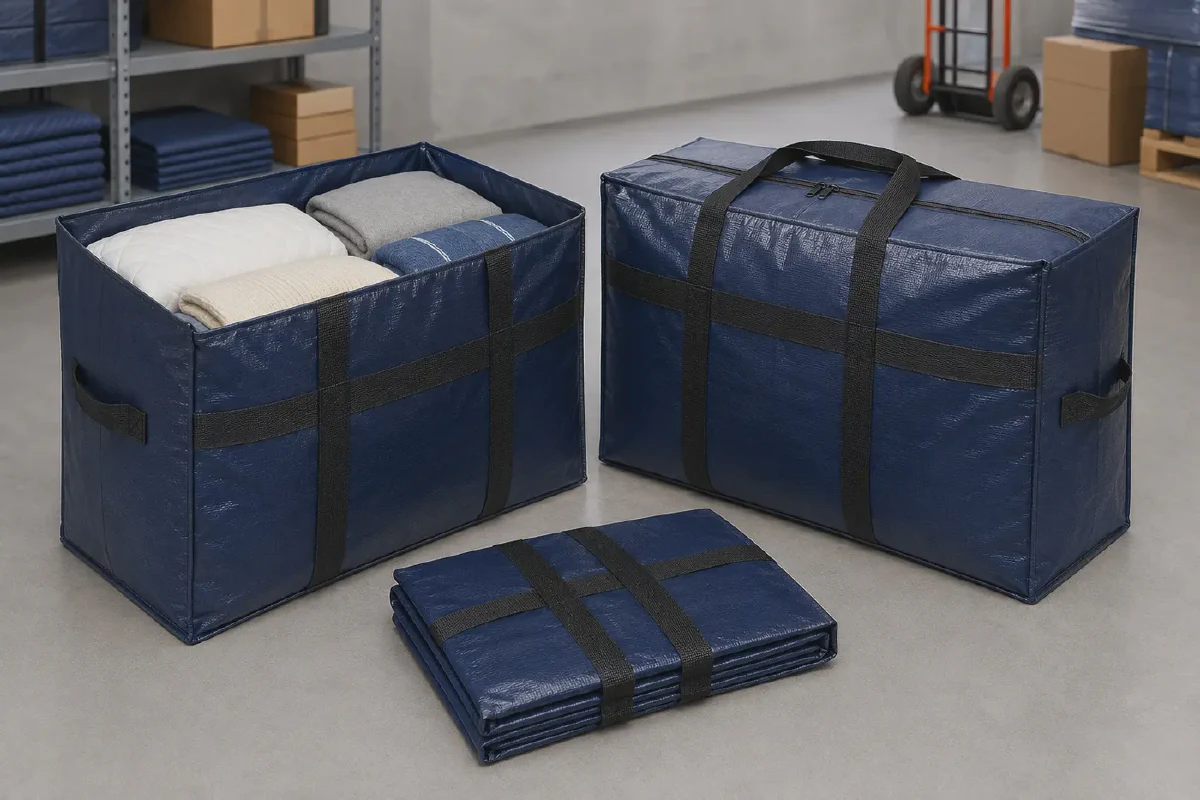
- Extended or wraparound webbing spreads force across a larger area and is often selected for dense or repeatedly handled contents.
- Side handles support two-person lifting, vehicle loading or pulling the bag from a stack.
- Shoulder or backpack arrangements require ergonomic placement as well as strength verification.
The lowest section of a wraparound strap must be integrated deliberately with the base and seams. A strap that only appears to continue around the bag may still create abrupt stress points at corners or stitch ends.
For a deeper engineering checklist, see How to Specify Handle Strength for Moving Bags.
6. Control seams, corners and the base
Moving-bag loads are rarely distributed perfectly. Books settle into corners, folded textiles push against side panels and users may lift one handle before the other. The seam and base design must manage these uneven forces.
Specify or approve:
- the seam type and allowance;
- thread and stitch consistency;
- reinforcement at handle ends and zipper ends;
- corner construction and gusset alignment;
- bottom seam or panel arrangement;
- binding where exposed edges need protection;
- a removable or fixed base insert, if required.
A base insert can improve shape and loading convenience, but the insert material, thickness, dimensions, edge treatment and packing method should be defined. It should not create a sharp edge that damages the woven body.
7. Add only the features the job needs
Extra features create value only when they solve a real handling or identification problem.
| Feature | Useful when | Detail to confirm |
|---|---|---|
| Label pocket | Rooms, owners or inventory must be identified | Position, opening direction and usable card size |
| Clear window or body | Contents must be recognized without opening | Visibility, reinforcement and privacy requirement |
| Side handles | Two-person lift or vehicle loading is expected | Placement, attachment and clearance |
| Internal straps | Contents need restraint | Strap path, buckle and load interaction |
| Custom printing | Brand, instructions or tracking are required | Artwork area, color standard and seam interference |
| Base insert | A stable rectangular shape is important | Material, size, removability and packing |
Avoid adding pockets, zippers or decorative panels merely because they appear in a reference photo. Each component adds cost, inspection points and possible failure modes.
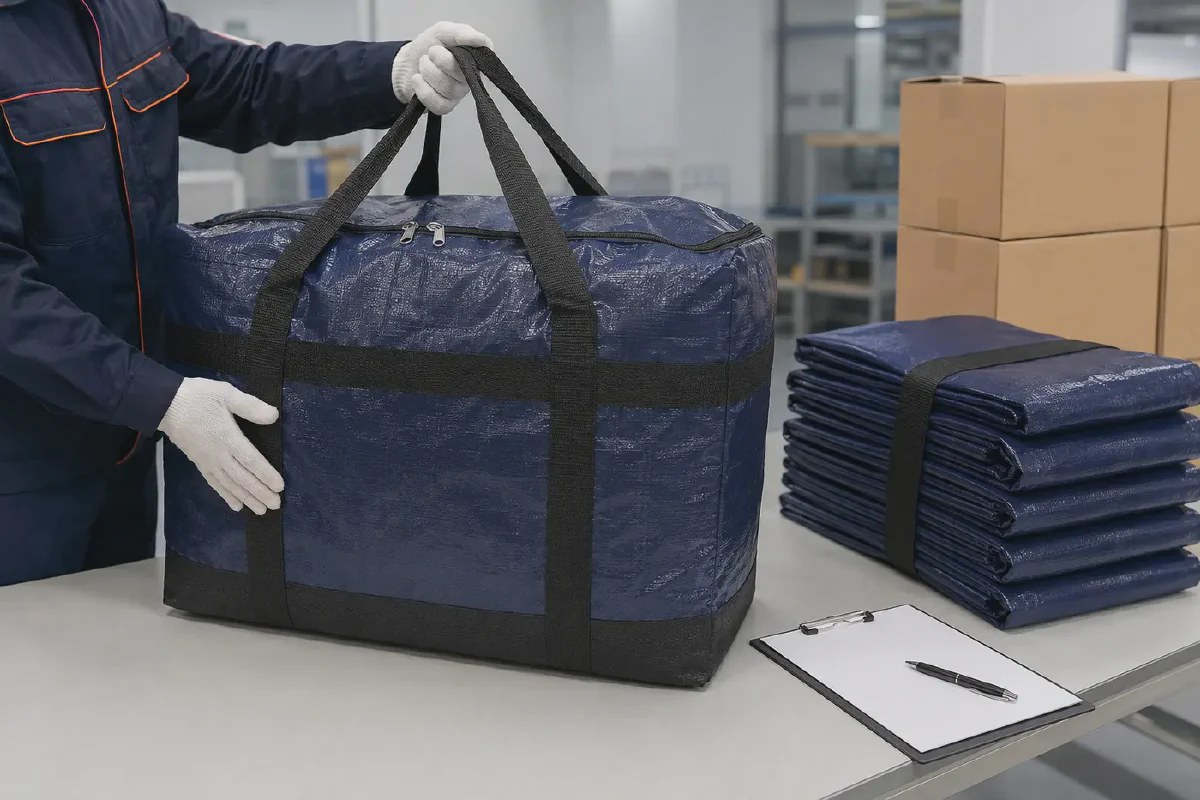
8. Build a production-intent sample
A showroom sample is useful for appearance; a production-intent sample is needed for approval. It should use the intended body, lamination, webbing, zipper, thread, print method and packing construction.
The sample review should cover three layers:
Fit and handling
Pack the normal contents, close the bag, lift it from the intended points and move it through the real route where practical. Check balance, body clearance, grip comfort, opening access and stacking behavior.
Construction
Measure finished dimensions, handle drop, webbing placement and zipper opening. Inspect stitch lines, reinforcement, corners, binding and any base insert.
Appearance and packing
Approve color, gloss, print placement, label pockets, folding method and the condition after unpacking. Excessive creasing or distortion may result from packing rather than sewing.
Keep the approved sample, signed specification and artwork revision linked by one product code and revision date.
9. Verify load capacity with a finished-bag test
A fabric test or webbing certificate does not prove the assembled bag will survive its intended job. The test must challenge the complete load path.
Write the test method before comparing claims:
- Define representative contents or a controlled load that behaves similarly.
- State the test weight and how it is distributed.
- Identify which handles are used and whether the zipper is closed.
- Define lift height, hold time, repetitions or handling route.
- Record the condition before and after testing.
- Set pass criteria for seams, webbing, body, zipper and permanent deformation.
The test weight should be chosen from the buyer’s real working condition and desired verification margin. There is no responsible universal load number for every size and construction.
10. Compare quotations line by line
A low unit price may reflect a lighter body, shorter webbing, simpler zipper, different packing or a carton that increases freight volume. Create a normalized comparison instead of comparing only price and MOQ.
| Quotation field | What the supplier should confirm |
|---|---|
| Finished size | Width × height × gusset, measurement method and tolerance |
| Body | Woven base, coating or film, color and tolerance |
| Opening | Style, dimensions, zipper tape, sliders and end reinforcement |
| Handles | Webbing specification, drop, path, side handles and stitch pattern |
| Construction | Seams, binding, corners, base and insert |
| Branding | Print method, coverage, colors and artwork revision |
| Testing | Finished-bag method, load condition and pass criteria |
| Packing | Fold, pieces per bundle/carton, carton size and gross weight |
| Commercial | MOQ, sample terms, lead time, over/under delivery and Incoterm |
Ask suppliers to mark every deviation rather than silently quoting an alternative. A quotation should identify what is included, what remains subject to sample approval and what requires additional cost.
11. Understand MOQ and total landed impact
MOQ is influenced by fabric color, lamination or printing setup, component sourcing and production efficiency. A stock-colored unprinted bag may support a different minimum from a custom-printed bag with special webbing and packaging.
Do not change specifications only to reach a lower advertised MOQ without checking the operational consequence. A cheaper but oversized bag may cost more to ship; a lighter bag may need replacement sooner; excessive individual packaging may add labor and waste.
Compare:
- unit price at realistic order quantities;
- sample and setup charges;
- carton volume and gross weight;
- expected loading efficiency;
- inspection and compliance costs;
- replacement risk if the construction is under-specified.
The best buying decision is the lowest acceptable total cost for the required performance—not necessarily the lowest unit price.
12. Specify export packing before production
Moving bags can occupy substantial volume even when folded. Packing design affects freight, warehouse handling and the appearance received by the customer.
Confirm the folding sequence, whether inserts ship inside or separately, bundle quantity, individual packaging, carton dimensions, carton strength, gross-weight limit, labels and pallet requirement. Request a packing photo or packed-carton sample where volume is commercially important.
Check that compression does not damage zippers, crease clear windows or permanently distort laminated panels. Carton size should be based on the approved folding method rather than an optimistic estimate.
13. Inspect bulk production against objective checkpoints
Final inspection should use the signed specification and approved sample, not memory. A practical inspection plan checks:
- quantity, assortment and packaging;
- finished dimensions and handle drop;
- body, lamination, color and print;
- webbing path and attachment position;
- zipper operation and opening access;
- seams, stitch consistency, corners and base;
- label pockets, windows, side handles and inserts;
- workmanship, contamination and odor;
- defined finished-bag functional test;
- carton dimensions, markings and gross weight.
Sampling level and acceptance criteria should be agreed according to order risk and buyer policy. Functional defects that affect lifting or closure should not be hidden inside a general cosmetic defect count.
Common sourcing mistakes
Buying from a photo
A photo cannot reveal base weight, lamination construction, zipper grade, hidden stitch length or packing method. Use it to communicate shape, then convert the shape into measurable requirements.
Asking only for “heavy duty”
The term has no single technical meaning. Replace it with working load, handling cycle, webbing path, seam details and an agreed finished-bag test.
Approving an empty sample
An empty bag may look correct but become unstable, difficult to close or uncomfortable when filled. Approve it with representative contents.
Comparing different quotations as if they are equal
Differences in body, film, dimensions, webbing, zipper and carton volume can outweigh the apparent price gap. Normalize the specification first.
Leaving packing until the end
Late packing decisions can change freight cost, creasing and delivery condition. Treat the packed carton as part of the product approval.
Copy-ready RFQ checklist
Send suppliers the following information in one request:
- intended application and typical contents;
- normal filled weight and handling route;
- finished width × height × gusset and tolerance;
- woven body, lamination, color and surface;
- opening and zipper construction;
- main handles, side handles and webbing path;
- seams, corners, base and insert;
- label pocket, clear window or other functional features;
- printing, artwork and color reference;
- order quantity and acceptable over/under delivery;
- production-intent sample requirement;
- finished-bag test method and pass criteria;
- individual, bundle and export-carton packing;
- destination, Incoterm and required delivery date.
Final recommendation
The most reliable moving-bag purchase begins with the real load and handling route. Convert those conditions into a measurable construction, verify the production-intent sample with representative contents, lock the finished-bag test and compare suppliers against the same packing and commercial basis.
When the approved sample, specification, artwork, test method and carton pack all carry the same revision, the buyer has a practical standard for quotation, production and final inspection.