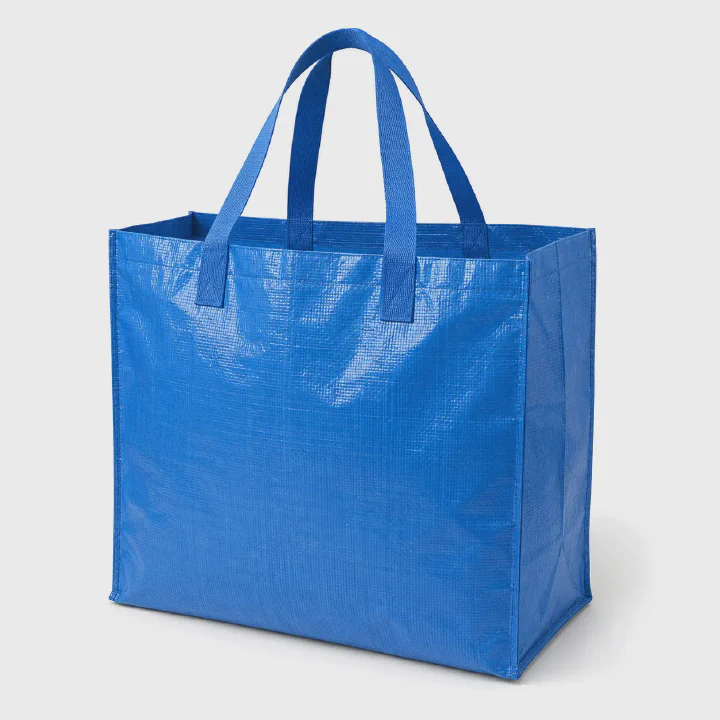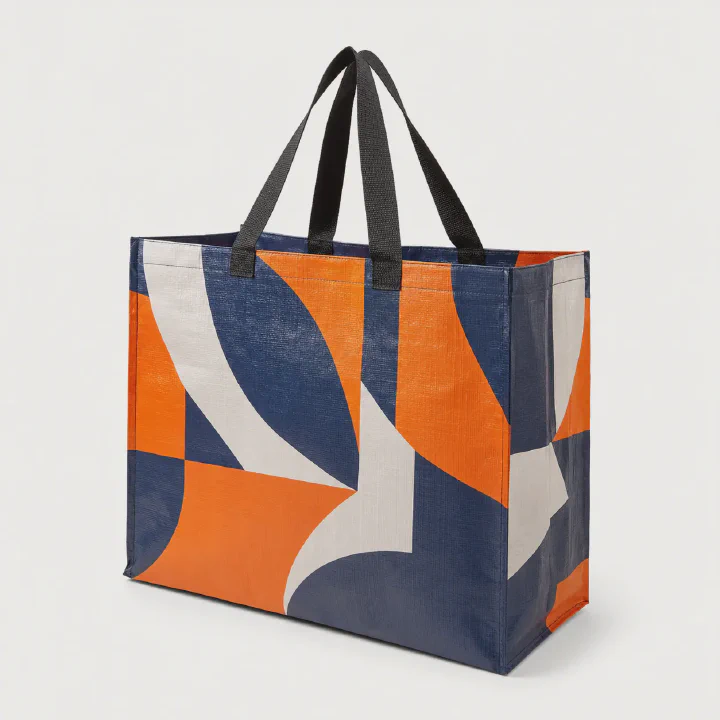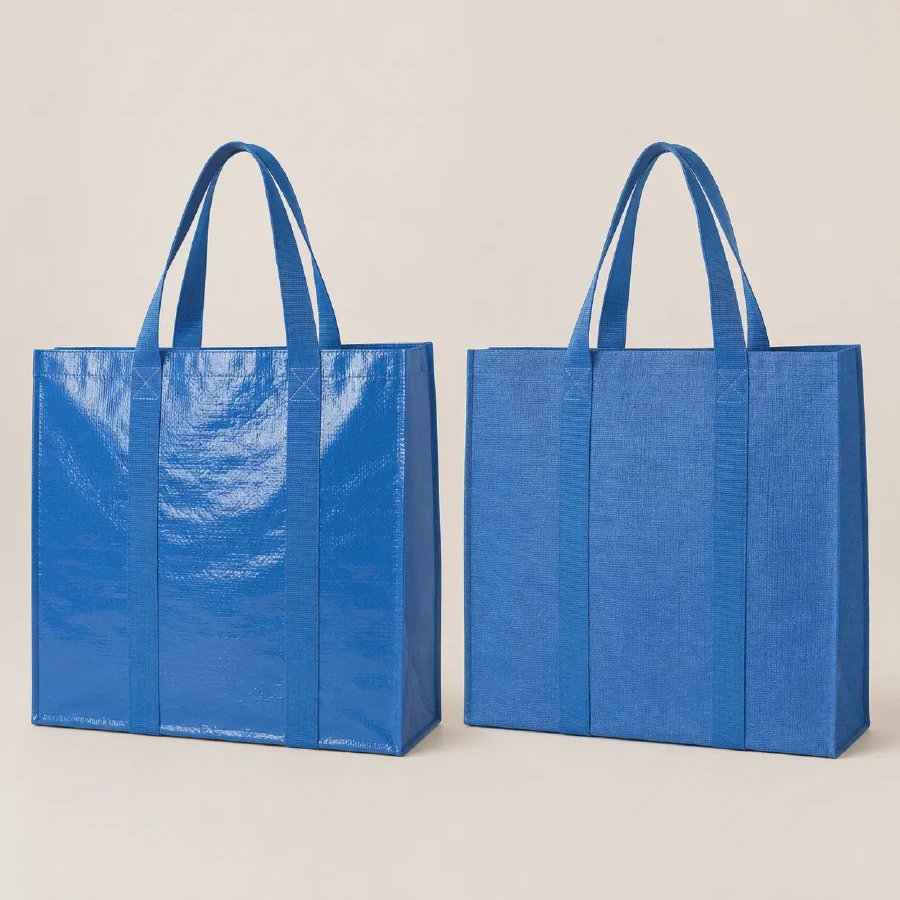
Short answer
Choose a laminated PP woven bag when buyers need a wipe-clean surface, improved resistance to light moisture, greater stiffness or detailed retail graphics. Choose unlaminated woven PP when visible woven texture, flexibility, airflow and a simpler lower-cost construction are priorities.
Lamination changes the surface; it does not automatically make the whole bag stronger or waterproof. The woven base, handle path, seams, closure and finished dimensions still determine whether the bag is suitable for its load. For an accurate quotation, specify the base fabric and surface layer separately rather than asking only for a total GSM.
See the available laminated woven shopping bag constructions for practical formats. If the film carries branding, use the custom printed woven bag artwork guide before approving production files.
Side-by-side comparison
| Requirement | Laminated woven PP | Unlaminated woven PP |
|---|---|---|
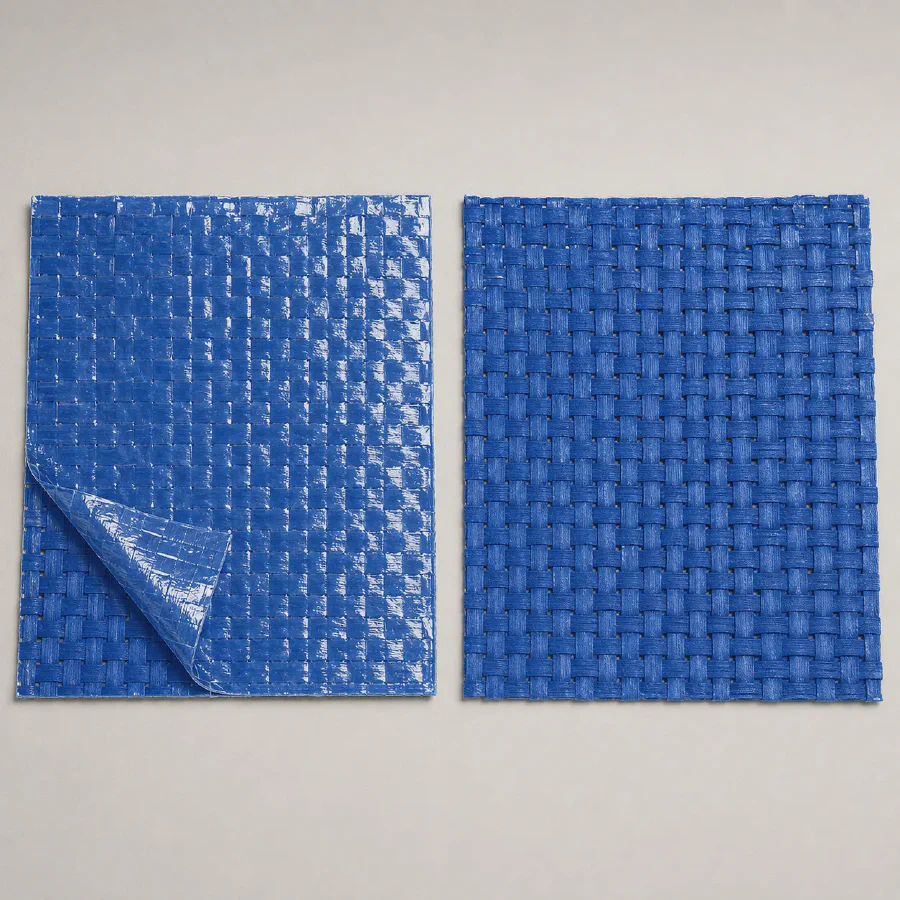
| Surface | Smoother, continuous film | Exposed woven texture |
| Cleaning | Easier to wipe | Dirt can sit within weave |
| Moisture | Better body resistance | More paths through weave |
| Printing | Detailed printed-film graphics possible | Best for simpler surface print |
| Stiffness | Usually more structured | Usually softer and flexible |
| Appearance | Gloss, matte or printed finish | Industrial woven appearance |
| Airflow | Reduced through treated panels | More air can pass through the weave |
| Folding | More shape and crease memory | Softer and easier to fold |
| Material complexity | Woven base plus coating or film | Woven base without an added film |
What “laminated” can mean
Suppliers sometimes use coated and laminated as if they mean the same thing, but buyers should confirm the actual construction. An extrusion coating applies molten polypropylene to the woven fabric. Film lamination bonds a separate film to the woven base. A BOPP printed film can carry detailed graphics and then be bonded to the fabric, often with the ink protected beneath the clear film.
These constructions can look similar in a website photograph while differing in stiffness, print method, film weight and price. A useful specification identifies:
- woven PP base weight;
- coating or film weight;
- one-side or two-side treatment;
- clear, colored, matte, gloss or printed surface;
- outside and inside finish;
- required print process and coverage.
Lamination options
A clear or colored film can be bonded to one or both sides of the woven base. One-side lamination is common when the buyer wants an exterior print or wipe-clean face while keeping the inside simpler. Two-side treatment gives both faces a more continuous surface, but adds weight, stiffness and cost.
A reverse-printed film places graphics beneath the clear outer surface, helping protect the ink and produce consistent full-color branding. It suits retail programs where color, shelf appearance and repeatability matter. Simple logos or shipping marks may not justify a printed film; direct surface printing on unlaminated or coated fabric can be more economical.
Do not compare quotations using total GSM alone. A supplier could reach the same total with a lighter woven base and heavier coating, while another uses a stronger base and lighter surface layer. Those bags may not carry, fold or print in the same way.
Moisture and cleaning claims
Lamination reduces moisture movement through the panel, but it does not seal sewing holes or closures. For grocery splashes and routine wiping, a laminated body may be sufficient. For wet transport, outdoor exposure or leak containment, define a test for seams, base, opening and zipper as well as the fabric.
Avoid the word “waterproof” unless a finished-bag test supports it. “Wipe-clean” and “moisture-resistant body” are more accurate for ordinary stitched shopping and storage bags.
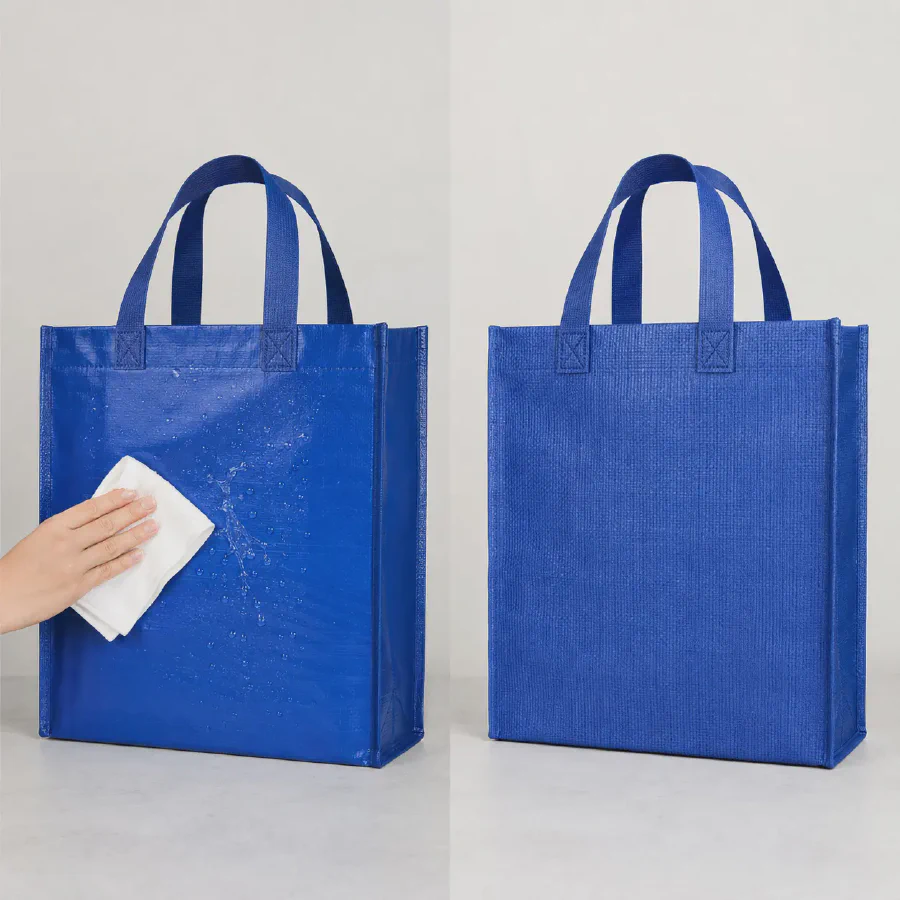
Test the finished bag, not only the fabric
If moisture performance matters, define the exposure rather than using a vague label. A supermarket bag may only need to tolerate a wet counter and routine wiping. A storage bag may face a damp floor. An outdoor delivery bag may be exposed to rain from several directions. These are different requirements.
The approval method can include a timed spray, a wet-cloth wipe, water contact at the base or a controlled fill test. Check seam lines, needle holes, binding, zipper tape and corners after the test. A coated fabric data sheet cannot prove that a stitched finished bag will prevent water entry.
Printing and retail appearance
Choose the print system according to the artwork and viewing distance. Direct printing is suitable for uncomplicated logos, limited colors and functional markings. Printed-film lamination is better for photographs, gradients, fine text and consistent full-area graphics.
Before production, approve the artwork at final size and identify safe zones around seams, gussets, handles and binding. Confirm the color reference, film transparency, gloss level and whether the weave should remain visible. A color viewed on a monitor will not show how film tone, base color and surface reflection interact.
For retail work, the approval sample should be viewed both flat and assembled. A design that looks correct on a panel can be interrupted by a side gusset or disappear beneath the handle webbing.
Stiffness, folding and handling
Lamination usually gives a bag more body and helps it stand open, which is useful at checkouts and packing stations. The trade-off is additional crease memory. A heavily treated bag may not fold as compactly, and repeated sharp folding can leave visible lines in glossy surfaces.
Unlaminated fabric remains more textile-like. It is appropriate where flexibility, ventilation or compact bundle packing matters more than a polished face. However, the exposed weave can hold dust and is less convenient to wipe clean.
Ask for the packed dimensions and pieces per carton as well as the open bag dimensions. A stiffer construction can increase carton volume even when its unit price looks competitive.
Which finish fits the application?
| Application | Usually preferred | Reason to verify |
|---|---|---|
| Branded grocery or retail tote | Laminated or printed-film laminated | Wipe-clean face and stronger graphic presentation |
| Promotional event bag | Depends on artwork and target price | Simple logos may not need film lamination |
| Dry agricultural or utility use | Often unlaminated | Airflow and economical construction may matter more |
| Clothing and household storage | Either | Choose by dust, wiping, ventilation and closure needs |
| Wet goods or outdoor exposure | Custom tested construction | Lamination alone does not seal seams or openings |
| Fold-flat bulk distribution | Often lighter or unlaminated | Check crease appearance and carton efficiency |
The lowest-risk choice is not always the most heavily laminated option. Extra film is wasted if the bag only carries dry goods once, while an unlaminated face can create cleaning or presentation problems in a long-running retail program.
How to specify the finish
State the desired gloss or matte appearance, print coverage, body color, acceptable color tolerance, cleaning method and whether the inside also needs a film. Approve a physical sample because monitor colors do not predict film gloss, opacity, weave show-through or final lamination color.
Also define finished width, height and gusset, target load, handle drop, closure and packing. Surface choice cannot be separated from the rest of the construction: a beautiful printed panel does not compensate for a handle path that is too light for the load.
Sample approval and quality checks
Use a pre-production sample or approved reference sample to control what matters visually and functionally. Record measurable tolerances rather than relying on “same as sample.” Useful checks include:
- finished dimensions and squareness;
- woven base and coating or film weight;
- lamination adhesion, bubbles, wrinkles and edge lifting;
- color, gloss and print position;
- rub or wipe resistance appropriate to the use;
- handle attachment, seams and closure operation;
- the agreed load and moisture test on a finished bag.
For repeat orders, retain a signed sample and production specification. This gives the factory and buyer the same acceptance reference and reduces disputes caused by subjective descriptions.
Buyer checklist
- Actual use environment and contact with moisture
- Woven base GSM plus coating or film GSM
- One-side or two-side treatment
- Matte, gloss, clear, colored or printed film
- Required flexibility and fold-flat behavior
- Artwork, color reference and seam exclusions
- Cleaning expectation and finished-bag test
- Target load, handle path and closure
- Packing method, pieces per carton and destination
RFQ wording that gets a useful quotation
Instead of requesting “a waterproof 160 GSM woven bag,” provide the intended contents, finished dimensions, target carrying load, expected reuse, base fabric weight, surface treatment, artwork, closure, quantity and destination. Ask the supplier to state the woven base and film or coating components separately and to identify the proposed test method.
The best surface is the lightest construction that reliably meets the use, appearance and cleaning requirement—not the option with the highest total GSM. If the buyer cannot yet choose, send the real use case and ask for one laminated and one unlaminated sample built to the same dimensions. Comparing equal constructions makes the surface decision visible without confusing it with size or handle differences.