Short answer
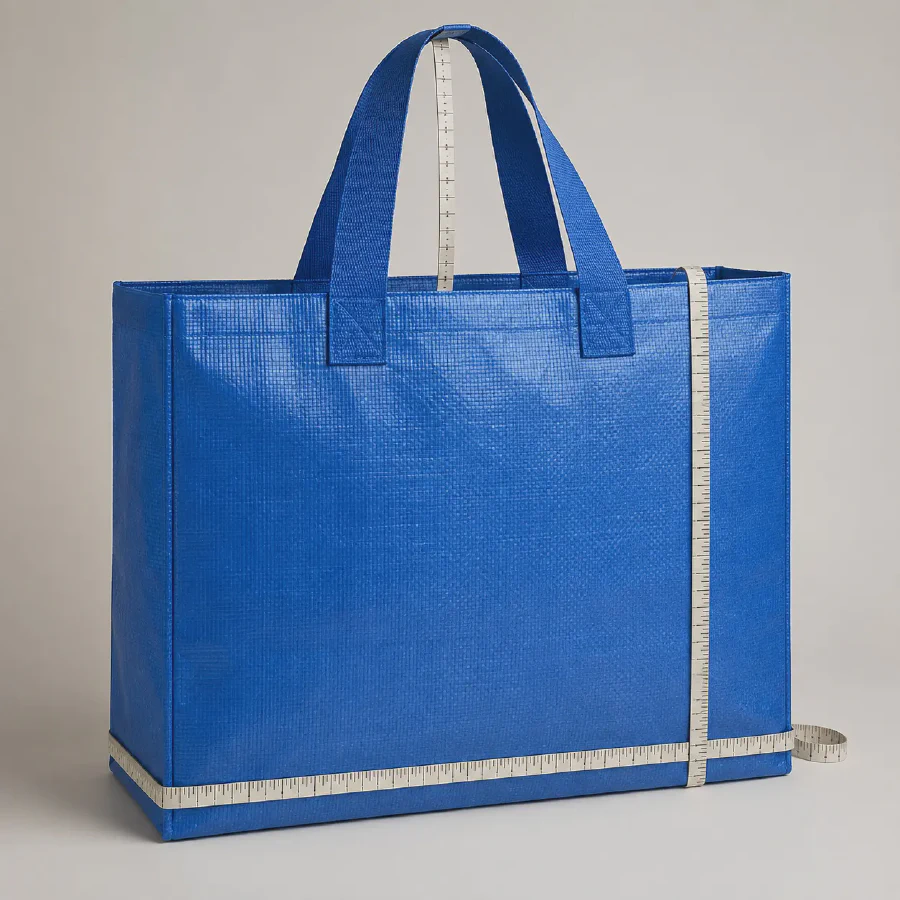
Choose reusable shopping bag size from the actual contents and handling method, not from a generic litre claim. Arrange the normal load as it will be packed, measure its combined width, height and depth, then add only the clearance needed for loading and closure. Specify the finished bag as width × height × gusset, with the opening, handle drop, target working load and dimensional tolerance listed separately.
A bag that looks large on a drawing can still be difficult to load, unstable on the floor or uncomfortable beside the body. The final decision should therefore be confirmed with a physical sample loaded with real or equivalent contents.
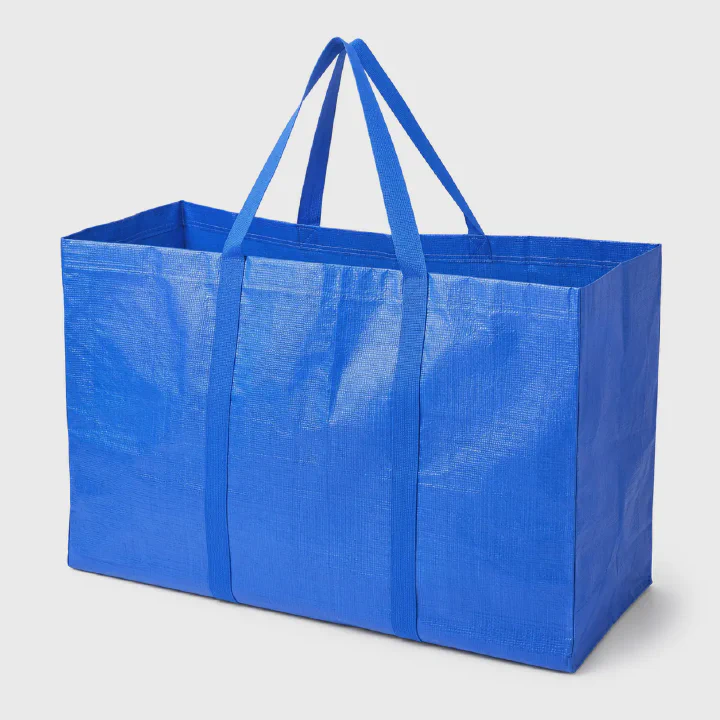
Use extra-large grocery bags as capacity references, but match dimensions to the real load. When filled weight is also a concern, specify the handle strength and attachment system separately.
What dimensions should a reusable shopping bag include?
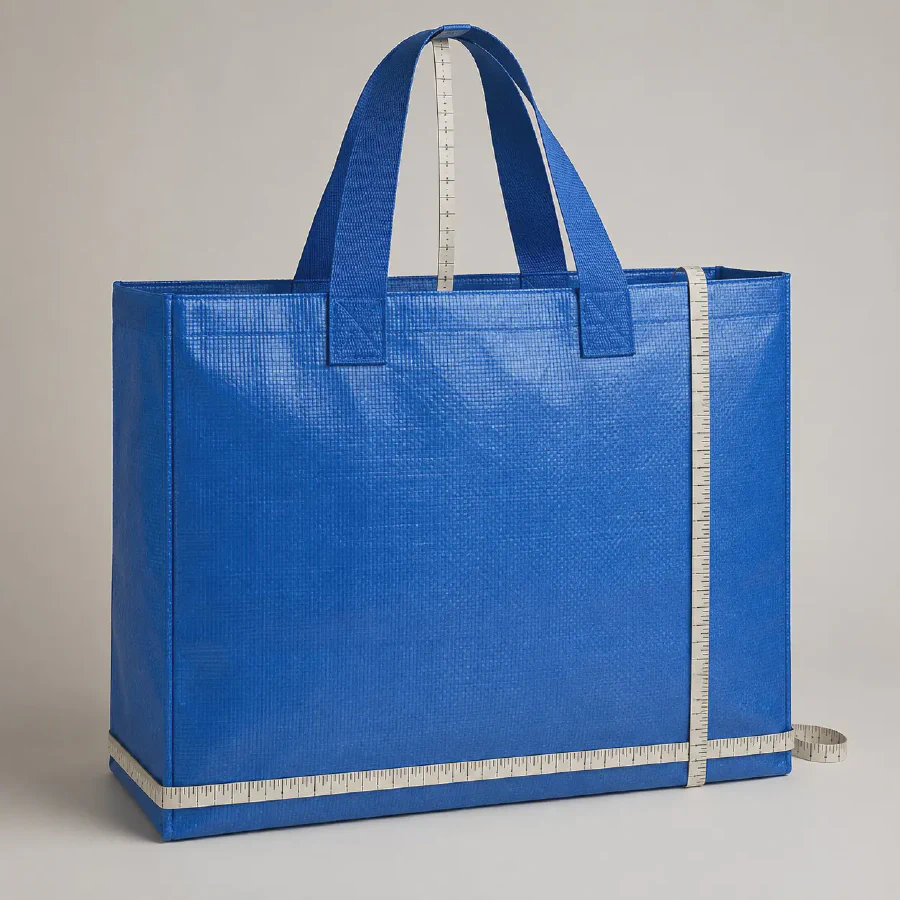
The standard purchasing sequence is finished width × finished height × finished gusset. Handle drop is stated separately because it controls how the bag is carried rather than how much the body contains.
| Measurement | What it controls | How to describe it clearly |
|---|---|---|
| Width | Front opening, horizontal load and body span | Finished side-to-side width when the bag is opened naturally |
| Height | Upright containment, visibility and closure clearance | Finished base-to-top-edge height, excluding handles |
| Gusset | Depth, base stability and much of the usable volume | Finished side or bottom depth when fully opened |
| Opening | Speed of loading and access to contents | Usable opening after zipper, binding or closure construction |
| Handle drop | Hand, forearm or shoulder clearance | Vertical distance from the bag’s top edge to the underside of the handle |
Do not send a drawing with three unlabeled numbers. Suppliers may read the order differently, and the same nominal size can produce a different usable bag when the gusset, seam method or closure changes.
Finished, internal and nominal dimensions are not interchangeable
Finished external dimensions are normally the easiest values to inspect consistently. Internal usable dimensions are smaller because seams, binding, a zipper, a base insert and the way the gusset folds all occupy space. A nominal dimension may simply be a commercial size name and should not replace an inspectable measurement.
For a custom order, state which convention applies. Also define whether the bag is measured empty and laid flat, naturally opened, or supported on a measuring fixture. The approved sample and bulk inspection should use the same method.
Start with the actual load envelope
The load envelope is the smallest practical rectangular space occupied by the usual contents in their intended orientation. It is more useful than choosing a bag from a photograph because it reflects what must actually pass through the opening and sit inside the gusset.
- Assemble a typical full load, including the largest regular item.
- Arrange the contents in the packing order used at checkout, in storage or during delivery.
- Measure the widest, tallest and deepest occupied space.
- Add clearance for quick loading and normal product variation.
- Add any separate allowance required by a zipper, flap or hook-and-loop closure.
- Check the result against the carrier’s body, trolley, shelf, counter and shipping carton.

This method prevents two common errors: selecting a narrow opening that the largest item cannot pass through, and adding so much spare volume that products fall sideways during transport.
How do you calculate reusable bag capacity?
For a rectangular bag, a rough theoretical volume is:
width × height × gusset ÷ 1,000 = litres, when all measurements are in centimetres.
For example, a 45 × 35 × 20 cm rectangular envelope equals 31.5 litres mathematically. That is not a promise of 31.5 litres of usable packed capacity. Corners round under load, the opening may narrow, seams and closures consume space, and rigid products rarely fill every void.
Use the calculation to compare proportions, then verify usable capacity with the intended contents. If an exact litre claim will be printed or used in a tender, agree on a test method rather than relying only on nominal dimensions.
Capacity is not carrying strength
Volume and load answer different questions:
- Capacity asks how much space is available.
- Working load asks how much weight the complete construction is expected to carry in normal use.
- Test load describes a defined verification condition and should not automatically be advertised as the normal working load.
A high-volume bag filled with blankets may be light. A smaller grocery bag filled with bottles may apply much more force to the handle attachments and base seams. Increasing width, height or gusset does not strengthen the bag by itself.
Tell the supplier both the representative contents and target working load. Fabric weight, lamination, webbing width, handle path, stitching, seam construction and reinforcement can then be selected as one system.
Choose proportions for the way the bag is handled
Two bags with similar theoretical volume can behave very differently. A wide, shallow bag offers visibility and a stable base but occupies more space beside the body. A narrow, deep bag uses less horizontal space but can make products difficult to reach. A tall bag may close easily around soft goods yet become unstable when filled with dense items.
Consider these practical checks:
- Checkout and retail: Can staff open and fill the bag without holding the sides apart?
- Grocery carrying: Does the loaded bag clear the carrier’s leg, and do bottles remain upright?
- Warehouse-club use: Is the base wide enough for bulky packs without becoming too deep to lift?
- Storage: Does the filled bag fit the intended shelf and remain accessible after stacking?
- Delivery: Does the body fit the vehicle crate, trolley or route-handling system?
- Promotional retail: Is the printable face large enough without creating unnecessary volume?

Set handle drop after choosing the body size
Handle drop should be selected from the carry method and the filled body dimensions. Short handles may suit hand carrying and controlled retail presentation. Longer handles can provide forearm or shoulder access, but a deep loaded bag may then hang too low or swing against the leg.
Measure handle drop vertically from the top edge of the finished bag to the underside of the handle at its highest point. Total webbing loop length is not equivalent: two handles can have the same loop length but different usable clearance because their attachment spacing differs.
For a shoulder-carry requirement, verify the handle with representative users wearing normal clothing. Do not approve handle drop from a flat drawing alone. The loaded sample should allow access without forcing the opening closed or concentrating the load uncomfortably on the hand or shoulder.
Allow for the closure and base construction
An open-top tote can use most of its height, while a zipper or flap needs headspace so the closure is not pulled across protruding contents. If the bag has a rigid or semi-rigid base insert, record whether dimensions are taken with that insert fitted. The insert can improve stability but also defines the minimum internal footprint.
Side gussets, bottom gussets and box construction do not open in exactly the same way. Confirm that the chosen construction creates the required base shape instead of assuming that identical width, height and depth values will perform identically.
Do not ignore tolerance, packing and freight
PP woven fabric is flexible, and finished sewing dimensions will have an agreed manufacturing tolerance. Put the tolerance on the drawing or specification and identify any dimension that is critical to fit. An unrealistic zero-tolerance request does not improve quality; it creates disagreement because flexible bags cannot be inspected like rigid plastic boxes.
Bag size also affects the order outside the point of use. Larger panels require more material, long handles increase webbing consumption, rigid inserts reduce folding efficiency, and bulky finished bags increase carton volume. Ask for the folded size, pieces per carton, carton dimensions and gross weight before approving a large format.
Sample approval checklist
Approve a loaded sample, not an empty bag alone. Check that:
- finished width, height, gusset and handle drop follow the agreed method;
- the largest regular item passes through the usable opening;
- normal contents can be loaded without excessive force;
- the closure operates without compressing or catching the contents;
- the base sits stably and the side panels do not collapse unpredictably;
- the bag clears the user’s leg and remains controllable while walking;
- handles and seams are assessed at the agreed load and handling cycle;
- the empty bag folds and packs as required for distribution.
Keep the approved sample, signed drawing and tolerance table together. They should be the reference for pre-production confirmation and final inspection.
RFQ template for reusable shopping bag size
Use wording that a supplier can quote and sample without guessing:
Custom reusable PP woven shopping bag. Finished external size: ___ W × ___ H × ___ G cm, measured naturally opened, tolerance ___. Usable opening: ___. Typical contents: ___. Target working load: ___ kg under normal hand/shoulder carrying. Handle drop: ___ cm. Closure: ___. Base insert: yes/no. Printing: ___. Quantity: ___. Individual/bundle packing: ___. Delivery country and postcode: ___. Please confirm sample measurement method, folded size, carton quantity and carton dimensions.
If the size is not yet fixed, send photographs and measurements of the arranged contents instead of inventing dimensions. A useful supplier should be able to recommend a starting construction, but the buyer should still approve the final loaded sample.
Final recommendation
The best reusable shopping bag size is the smallest practical body that loads quickly, closes correctly, carries comfortably and protects the normal contents. Define the load first, separate volume from weight, specify width × height × gusset and handle drop clearly, then verify the complete system with an agreed sample and measurement method.